The Chipmunk v. the Mouse

Judith Peck, Ed.D.

Chipmunks are cute and adorable. Mice are deplorable, not cute at all, but why the stark difference? Both are rodents— run as fast, eat, and intuit similarly, even look a bit alike, except for one thing: one is pretty and the other is not. Chipmunks have colorful stripes and a cute nose and puffy cheeks. They both keep their distance, though mouse hides, sort of knowing he’s not a pretty thing to you, and certainly not wanted, while chipmunks runs and darts around like it’s you who are on his turf and not the other way around. Chipmunk does things that amuse you, like stand on his hind legs and munch on a nut, spilling the shells from his adorable cheeks. He’s earned that nut, scavenging for it, and eating it is his just reward. The only time you see mouse is the split second he appears across the floor to scare the wits out of you or sprawled out in a trap. He’s stealing whatever he finds in that kitchen, even though you yourself have tossed it or left it out. Both seem forever hungry, but chipmunk is a winner whatever he does; mouse is a looser.

What a difference between chipmunk and mouse and what’s the winning lesson? Well, it’s better to be pretty. Statistics have shown that – in politics, education, love, money – success. And it helps to be colorful and cute and have a few appealing tricks. All that works for the outside looking in, but how much are you really able to use from achievements that accrue from that vantage point to meet a personal success mark? Achievements you’re not sure you even want? Being exceptionally pretty – beautiful – has its downsides: you may begin to depend upon it to the exclusion of efforts that might make you happier; and, of course, time and travail will take its toll. The productive perspective is from the inside looking out, if we have the courage to separate the two. There, we are the undisputed expert.

Sometimes we feel ourselves to be the chipmunk, spunky and adorable and charming, a little flirtatious, gripping attention, holding court. But more often, the little mouse appears: scurrying about with nobody noticing except when we get in the way or do the wrong thing. Then we feel unremarkable at best and unlikable at worst.

Hunger motivates our actions either way, just as it does chipmunk and mouse. We’ve learned how to satisfy these motivators and adapted the means to our needs. But we’ve got something neither of those guys has, a real game-changer when it comes to that self-perception, and that’s attitude. How we feel.

Best it is to feel like a chipmunk. We should because we are adorable to some if not all. We know this by the way such admiration is expressed in words or actions or sometimes never expressed, merely intuited. Best it is to keep our mouse in perspective: were it to look at itself and have the benefit of reflection, it would perceive a lovely creature, doing as prescribed, true to its nature and rather inventive in its efforts. Best it is to be yourself, savoring the kinship of your burrow and venturing out to the many fields beyond, alone or in company with the selected folks who accept you as adorable.

Posted in Blogs | Tagged , , , | Leave a comment

Glimpses

Judith Peck, Ed.D.

A large table in my bedroom had been moved away leaving a whole corner area empty. The next morning seated and lacing my shoes I glanced at the empty space so previously cluttered and was seized by a glimpse into the future. Not my future, for I was no longer here as I was dead; my bedroom existed as simply space.

Using my hands as blinders, I captioned off that corner space and it no longer held an eerie glimpse into the future. Instead the room fell into place as it belonged. There were the black slacks slung over a chair, the rumpled bed, the cascading books on the night table, the earrings and neckless I hang on myself as adornment in the world outside my bedroom door. All that crumble and clutter, glitter and immediacy.

I had a similar glimpse into future when my daughter embarked upon the task of slimming down a bookcase that appeared to beg for release of discomfort. Watching her from a nearby couch, the glimpse came over me: this old body gone and other daughter joining her to empty the books and other possessions transformed into the detritus of my life.

How these glances into my future (again, not mine) occur seems oddly similar to a being inside me who appears quite often, not depressingly but on occasions in life’s full flower. This observing self is the disembodied “person” I complain to when fretting about someone’s behavior that I can’t talk about to real folks. I talk and talk, the grievances passionately articulated with not a breath exhumed. Not that there is relief because the aggravation remains, though the phantom never tires of listening.

So, who is this listener, observer—that second self waiting in the wings to appear when summoned by the script I write, direct and act in? I suppose it is my mother, she to whom at bedside I could complain about childhood injustices with no repercussions from the villains. She offered calming words of advice, perhaps—in retrospect just to get me to sleep—but the overarching message was that she cared.

Who else cares like a good mother? The ears and eyes of a good mother probably continue to reside in a child to become that phantom, the interested listener. Just as sleep allows daily experiences to be organized and unimportant images discarded to refresh the brain, the phantom figure affords some needed equilibrium. I love this lady, this other me: She provides a forum for my aggravating grievances to sputter out and she gives license for the utterance of forbidden thoughts. Like sleep, she frees the emotional airways to breathe in all the challenges of a new day.

Posted in Blogs | Tagged , , , | Leave a comment

The Real Thing

Judith Peck, Ed.D.

It struck me that I was looking out at a landscape that was in these moments completely untampered with. The scene was natural, pristine, real. How unusual to feast on something, so genuine. A mist covered the trees and the lawn, a fog not yet lifted embraced everything, joining disparate surfaces and soothing their textures. The air was so still, not a single leaf fell, though it was the 10th day of October. Then at last a lone one did, cascading gently and wavering as if reluctant to fall at all. So still the air, tall trees majestically standing with their vast network of leaves immobile, as if waiting for a whisper from somewhere to summon movement.

I thought about what else in my life was genuine; not a product of something else; something that was as pure, albeit far from simple like those intricately complex trees that would never be completely knowable. My children, of course. The love between them and among us within the complexity of our lives. How fortunate each of us were to share that love as thick as this embracing early morning mist.

But how strange, I thought then, suddenly aware there was no movement of animals to be seen inside this silent mist. The scurrying I saw every morning, chipmunks racing across the lawn quicker that I could draw a pencil line, squirrels in circular leaps with short stops sitting upright to split open and munch an acorn. No birds, not one, nor deer trotting from the woods to steal whatever flowers remained. Everything seemed waiting. Too still, too quiet, eerily so. Like a moment in time stopped, the clock no longer racing forward. Nothing in motion, either forward or spinning around.

I went inside the house. On the news I learned that Hurricane Michael had just struck the Florida panhandle, the worst storm in its history. But no impending storm was predicted here. I put the eerie morning sights out of my mind and started my day, settling on the notion that the natural world in my backyard had engaged in a moment of silence for its kin.

In the afternoon, I stepped outside for a break. High above me, branches gently swayed, multi shades of green leaves glistened in the sun; a chipmunk crossed my path scratching itself between its runs; a bird swooped so low it startled me; squirrels shopped and gathered high in the oaks; acorns fell, one hitting me squarely. Bald spaces on the lawn revealed themselves, puddles lingering on the chairs, rust spots marring a table. Time was moving swiftly, dragging with it an imperfect world careening by: my intricately complex children and the puddles splashing at them and among them, my marring rust spots, the bald spaces that needed filling and maybe never would be. I reveled in it all.


Posted in Blogs | Tagged , , , | Leave a comment

Getting Started Creatively

Judith Peck, Ed.D.

How to get started creatively in the morning on the stuff no one in your world cares if you do it or don’t? You have not started, you feel despicable and cannot stand yourself. You have chores with factual beginnings and ends, you have some kind of business, you have an array of survivor tasks that bond you to the world at large, and you have loved ones who collectively gnaw. Compounding this are emails endlessly streaming in like wild dreams whose source you cannot control.

Longing for a pre-online world is no solution nor is the 75 or 80 times you look out the window as if something out there can ignite a fire, or you fling open the refrigerator door to find solace in sustenance. Better keep water glasses there to sip while you count the calories of solace and close the door.) What is the solution?

God knows. And that is simply an expression, not an answer. Help is not on the way. Nor is finding the source of your shame, guilt, your crushing despicability. Perhaps as a start: shut off the computer, the iPhone, the door to the kitchen if by the grace of that God you have one and sit down to make believe you and your yellow pad are once again alone together. Then write something, anything, until the pain goes away. Mysteriously, it does and you are on your way.

Detours to the refrigerator occur anyway, but you are coalescing a thought, so it is productive.

Posted in Blogs | Tagged , , | Leave a comment

Conflict Resolution: You are Right and So is He

Judith Peck, Ed.D.

You are absolutely right in the dispute, no question. He has inflicted a wrong-doing upon you, the logic of which is obvious. He is simply too thick-headed to see it; lives in his own world; blind to the truth; unwilling to face facts. Those are the facts as you see it, the sub-text: he doesn’t give a hoot about your feelings, doesn’t care about you, let alone love you, let alone like you. But there he is, claiming the exact same hard-fact complaints about you. Only the subtext isn’t there because men are trained to keep feelings un-watered—no tears—and these dry up  unrecognized as living things.)

Could both of you be right? Yes, because the logic of the situation belongs exclusively to each of you and is different for each of you. That logic, which brought on the firestorm, began with a hypothesis. From that, your argument and his proceed on their  own trajectories through to the blow-up finale. Without hearing (e.g. listening) to the other’s hypothesis and following its logic to the end, both of you have nothing to grasp at but anger.

Okay, here is an example: He wants to stay home and watch the playoffs on Sunday; she wants to accept her parent’s invitation to come for dinner before they leave for Florida. His hypothesis and the logic that follows is he works hard all week, Saturdays is full of the chores (she gives him) and come Sunday he is entitled to relax and do something he likes. Her argument: she needs to accept the invitation; her parents have given her so much and here  they are leaving for the whole winter. Each is right, traipsing along the yellow brick road of their arguments. But here come the side-paths the two stumble on, as neither one truly hears the other and their anger escalates: all you do Sundays is lie on the couch, she says, you should exercise, just look at that belly. He says, Your father is a grouch and never approved of me, and your mom makes pot roast for dinner when she knows I like steak. She counters defending her dad’s naturally gruff nature and her mom serving soft food for the man’s dental problems while he defends his bodily contours, and they’re off. Something has to intervene to help as the trail of logic hits a blockade and neither of their personal GPS’s work.

Enter empathy. That is, achieving the insight to understand why the other one feels wronged; stepping into the other’s reasoning; creating a bridge on which to move. This is hard for adults to do in the throes of anger and resentment. It’s impossible for young children in their disputes because they lack the maturity and experience to cultivate empathy (though parents can cultivate this—giving them the responsibility for feeding and walking a pet, for example, to feel its needs.) So, how should the couple disputing play-offs versus family obligation proceed?

First: Let go of who is right. That’s because both are. Their feelings are truthful.

Second: Start moving across the empathy bridge by accepting that truth. He feels he deserves to do what he wants on Sunday plus he remembers watching the games with his father every Sunday plus seeing the play-offs is a matter of urgency—no matter to her that all that running around after a ball is ridiculous. She feels guilt from a history of rebelling against her parents plus she rarely visits them in Florida while her sister does it routinely plus her mother loves making pot roast for family which she calls her signature dish—no matter to him she should grow up already.

Third: Now that they are traversing the empathy bridge they make an honest effort at listening; truths of the past they never thought about may even emerge to change an argument to enlightenment.

Fourth: Accepting #’s 1, 2 and 3, they set about finding a resolution. This might be her coming to dinner and him arriving later after the play-offs. She explains to her folks its importance to him. He waits for the results but not the post mortem commentary and arrives in time for a signature lemon meringue pie to wish the folks well in Florida.

Sometimes, unfortunately, resolution of a conflict is not wanted. This happens when chronic argument deteriorates to become the event that excites, when asserting power and inflicting emotional pain becomes the goal. Or to a lesser and more common situation, when winning an argument takes precedent over the health of the relationship.

As adults, we have the maturity to acquire empathy and the wisdom and skill to use these in interpersonal relationships. It takes all three—maturity, wisdom and skill—to accept that people form their opinions from personal perspectives. They create their hypotheses to support those perspectives and make logical statements supporting this. Conflicts that ensue because of a counter perspective and a disputed logic can be resolved with no one shamed or blamed, by crossing the empathy bridge. To be able to do that leads to one of life’s greatest pleasures, fully enjoying the company of others. Especially, a partner.

Posted in Blogs | Tagged , , , | Leave a comment

CONNECTING

Judith Peck, Ed.D.

Seated on my patio enjoying my lawn, I looked up and saw a young deer – teenaged in human terms – staring at me. I stared at her. Motionless, we engaged with one another until I felt a need to break the long moment. I said “hello.” (Do deer talk? I have never heard a peep from them.) Unmoving, the doe took several minutes to ponder the subtext of my greeting and then loped off. She did not run, clearly signifying our equal entitlement to the greenery between us. Point made, she’d simply had her fill. But we had locked eyes, entered the small world of each other’s universe and once aware, could not simply ignore each other. We were together in the moment, but we did not connect. Our intentions, let alone biology, were too different. She wanted to eat, I wanted to watch her so our situations accommodated us both. Not without reservations, of course, which all relationships must endure: Her extended family had consumed every tiger lily and daisy in the garden. Which I accepted in time and forgave.

Something similar happened on the same patio in my relationship with a muskrat. I think it was a muskrat or maybe a mole—something beginning with an M. (No disrespect, sometimes I wake in the morning feeling like something beginning with a J.) He emerged from his deeply dug habitat, the sneaky rodent having tunneled a vast domain under the pachysandra into which I once plunged barely escaping the demise of a leg. Enticed by morning sunlight and the smell of coffee, like me, the fellow ventured out and near to where I sat. As though he’d never seen a human, he stopped to look directly at me. Once again, as with the doe, I could not contain myself from greeting him. “Good morning,” I muttered and hearing this unexpected voice he turned and bolted to his hole. (How do creatures live without talking?) Amazingly, and here is the thrust of my account, shortly he returned. Never before had I sighted this night-time creature nor had he encountered this daytime creature, but curious, he risked dangerous open territory to check me out. Having seen only his dugout—admired it in fact, after almost sinking into it,  I was equally curious to see him. This time he stayed a few moments longer. I shut up. We locked eyes; we connected, we shared our curiosity for one another. Until I couldn’t help myself and said, “How are you?”

How deep is the need to make connection! Every once in a great while, we have a rich conversation with someone and feel the intensity of locking minds or blending sensitivities. It is always thrilling. Not roller coaster thrilling, more organic as if coming from within: Sparks of thought ignite into little flames rising and brightly dancing about, as words form and are articulated, igniting other thoughts, imaginings. A creative event.

We spend time searching for such connections—consciously, as when we look for good theater or a dramatic movie or pull a book with an intriguing title from a library shelf, but other times not even aware that we are looking. Barely noticing the emptiness that lingers inside, dry and even a bit rancid like ripe fruit going bad. Stuff that hangs around, at its best rather listlessly within our routines and customary interactions.

Once in a while, though, spurts of connection bordering on that exquisite intimacy of shared perceptions occur. These might emanate from a provocative exchange with a shopkeeper, a stranger sitting beside you on a bus, a fellow dinner party guest. Or a shared curiosity compelling a connection (like the mole and me—I’ve decided he’s a mole). If you’re lucky, there’s a friend you have a meal with, maybe even regularly, who is interested in you enough to listen and ask questions and just as interesting to listen to.  Or if you’ve caught the brass ring, a partner.

Connecting: you know when it happens whether transitory or sustained. You enter together a threshold that you sense is sturdy enough to hold an exchange of solid thoughts but flexible too, so your separate attitudes can bounce high like kids on a trampoline. And then drop safely down with no hard feelings and make you eager to fly skyward again.

Posted in Blogs | Tagged , , | Leave a comment

Taking Myself Out To Lunch

Yesterday, I had a strong desire to make a lunch date. I wanted to be social or more likely, put off further what I was putting off. I ran through the roster of candidates. Sonia was bright and informed and would love to meet, but Sonia had cousins. On any subject of conversation—political, historical, academic—she had a cousin who did that, an expert in the field and that one’s credentials would rise, burying the subject. Fran always called me to go to lunch and I sifted through that scenario. Fran was a devoted friend, smart as a whip in her job as an analyst. But that is the subject we talked about, her job as an analyst. I knew every co-worker over and under her, I knew every snipe and jab and woe and shared her exhaustion. Bonnie was an old friend and up on everything; a political wonk like me, read my kind of books. About to text her, I recalled laboring to get a word in edgewise about my take on Trump, my assessment of  Hillary’s What Happened, my whatever and eventually, my frustration.

I’m a good listener and I like learning something new, always seeking a hidden nugget under the brittle shell. But what I wanted going out to lunch was the give and take of a good conversation: listening and speaking and affording space for the transition between the two, space to articulate a thought and thereby bring it to fruition. A good conversation is like a work of art, the awakening of a thought or memory or insight, then bringing it inside to expand toward something else or simply to retain with a comfortable sense of a new occupant residing in your psyche. I had to accept that the GC wasn’t going to happen with these ladies, likeable as they were.

So whose company would I want to lunch with? Of course, it would be my own. I knew it the next day approaching my favorite diner at the lunch hour. I instinctively took a table on the busy side, not the “dining” side in deference to its being a functional event. From time to time, a lone man entered to sit at the counter (men are all about function), no lone women. Tables all about me had munching and chattering couples of mixed genders. The waitress, cheerful and efficient, took my order of coffee and the chicken salad sandwich special. We negotiated the substitution of cold slaw instead of soup. No sooner had she walked away, a warm feeling came over me. I recognized it as happiness. It took only a moment more for thoughts about the novel I’d been working on to enter my head. A problem floundering in my brain began working its way to solution. A thin string of narrative appeared there; I followed it as my coffee came and I poured the milk and sipped; I hung onto the floating string as you sometimes do in early morning when you try to catch a dream by its tail before it disappears as the light begins coming up.

Oh, I was having a good time. The cheerful efficient waitress brought me extra cold slaw and refilled my coffee several times. So much chicken salad filled the rye bread, I had to bring it home along with the slaw. I gave her a 40% tip and still it was a bargain. Back at home, the glow of happiness lingered and I said out loud—to the same nobody as sat with me at the diner: “I have a good life.”

Back to work later that day, I could not resist mumbling to the vacant face of my computer, “We should do this more often.”

Posted in Blogs | Tagged , , , | Leave a comment

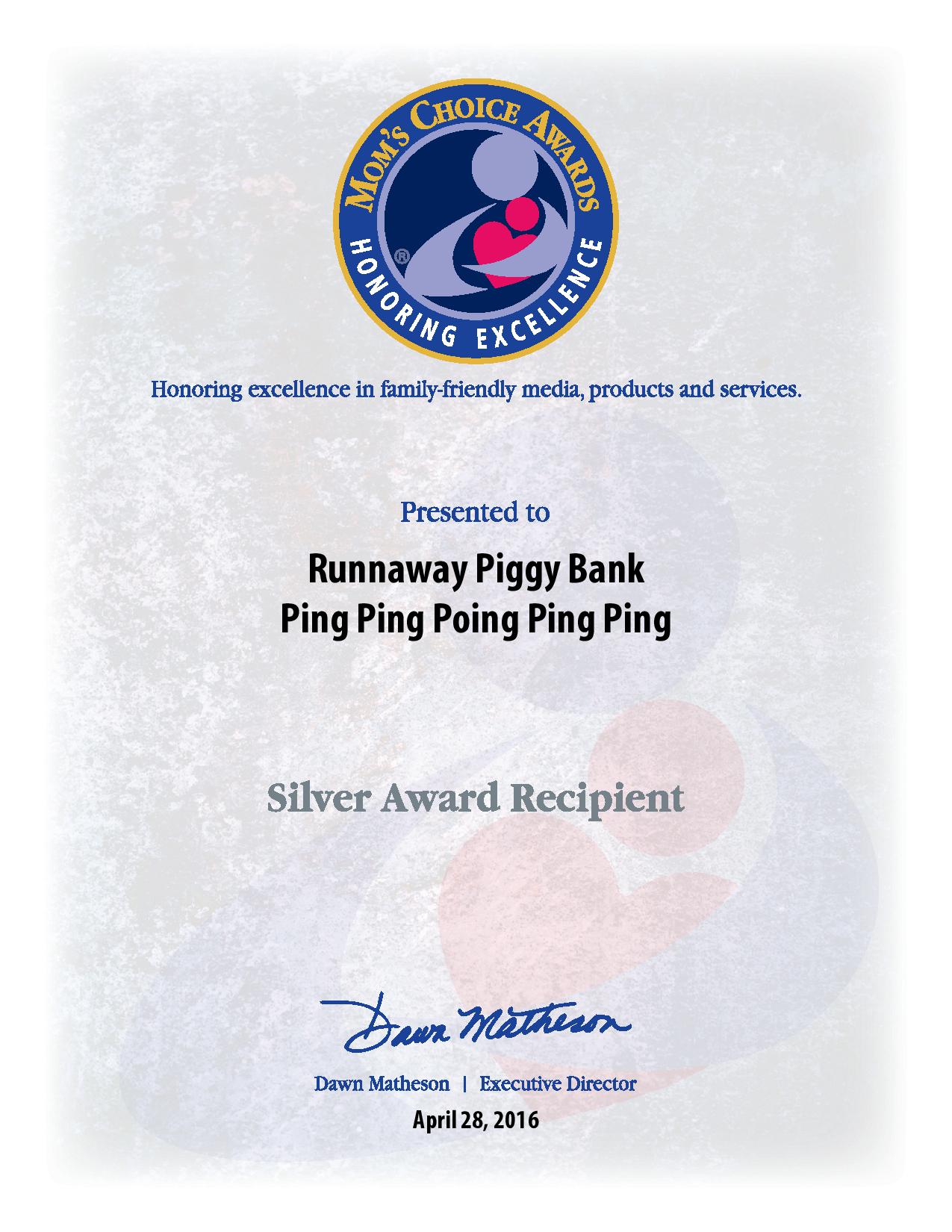
Mom’s Choice Award For Runaway Piggy Bank

I am pleased that my children’s picture book , Runaway Piggy Bank, has received this prestigious award.

Posted in Updates | Leave a comment

The Joy of Games

The Joy of Games

Yes, life is better after 50 in many ways, but in a group setting, we may not have the Moxy to jump in as we did when all young and flirty. And overall that’s a good thing—a little reserve goes a long way towards being both comfortable and comfortably accepted. In my groups—mostly folks in their seventies and eighties—conversations about politics, the state of the world, cultural experiences and, of course, health take center stage. Jokes and humor in general happen one-on-one in the wings if at all.

I miss the jokes that used to go around the dinner table, especially if there was someone particularly good at telling them. The teller had to know he/she was good—at timing delivery, voice projection, an accent if called for, and most important not forgetting the punchline. But you needed Moxy to preside like that, which is probably why jokes at the dinner table were BF50. There’s no question, the lightness of humor makes you happy and makes for terrific interaction in a dinner party. Having a good time never goes out of style and is what we all want at party-time (notwithstanding that making dinners are replaced by dinner reservations—play dates for grown-ups.)

A few days ago, having bought a sizable chicken to roast, I decided to invite friends who live nearby to join my partner and me for dinner. This is a couple living together for more than forty years, ardently on the opposite side of politics but adoring each other nonetheless. They watch TV in separate rooms when politics and football is on, screams searing through the rooms as they shout at their screens, but they sleep in the same bed.

At any rate, conversations about politics and even world events off the table, and loving jokes but dropping every punch line like a sledge hammer, I decided to wrap my dinner party around game-playing. If you have never played Chinese Checkers you might consider getting a set. Though the hang of the game is mastered in three seconds, it is mentally challenging (happily not too much) and lots of fun. Players are from two to six, so anyone can opt out and not spoil it for others. Each player chooses a color. The competition grows as each player tries to get to the opposite side of the board by moving their pins a single step or jumping others, yet opportunities for praise are bountiful. When a player makes double, triple or quadruple jumps in a single play, high praise is forthcoming. This allowed me, having rebuked my mate for helping not a whit in prep for the party, to make amends when he scored a triple play. Our guests, meanwhile, came in first and second, making us all happy, not thinking any longer that the chicken was kind of dry left in the oven too long.

There doesn’t seem to be anything Chinese about those checkers. Maybe its lessons are wisdom from Confucius. There are other fun grown-up-play-date games; my daughter, Jennifer, likes Banana Gram. I’m including a game at my next dinner party served between dinner and desert. If guests don’t leave as winners at least they’ll have a sugar high.

Http://www.AriellesStory.com

Posted in Blog Post | Leave a comment

Mom’s Choice Award For Runaway Piggy Bank

I am pleased that my children’s picture book , Runaway Piggy Bank, has received this prestigious award

.piggybankaward

Posted in Books, Updates | Leave a comment